Part IV — Smartphones · Chapter 12
Smartphone Architecture
≈ 4 min read · Print / save as PDF
A phone is a sandwich: screen, frame, logic board, battery, back. One main chip (the SoC) does the computing, and a power chip (the PMIC) makes all the voltages from the battery.
Main blocks
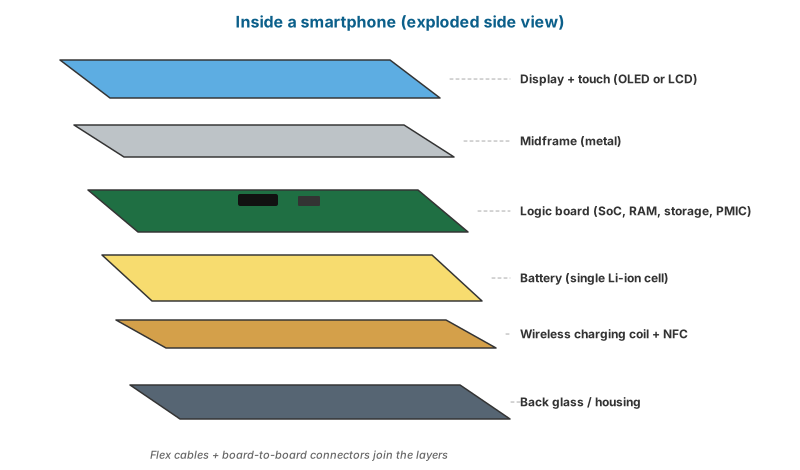
| Block | Description |
|---|---|
| SoC (system-on-chip) | CPU, GPU, image processor, neural engine, memory controller. Examples: Apple A-series; Qualcomm Snapdragon; MediaTek Dimensity/Helio; Samsung Exynos; Google Tensor |
| RAM | LPDDR, often stacked on top of the SoC (package-on-package, PoP) or mounted beside it |
| Storage | eMMC (budget phones), UFS (most Android), NVMe-based NAND (iPhones) |
| PMIC / PMU | Main power-management IC; generates most rails from battery voltage. Phones often have several PMICs |
| Charging IC | Controls charging current, power-path, sometimes wireless charging |
| USB/port interface IC | On iPhones with Lightning, the port controller commonly called Tristar or Hydra by technicians; on USB-C phones a USB-C/PD controller |
| Baseband / modem | Cellular radio (integrated in some SoCs; separate on others). Apple uses Qualcomm modems in most models and its own C1/C1X modems in some 2025-onward models |
| RF front end | Power amplifiers, filters, antenna switches |
| Wi-Fi/Bluetooth module | Usually a shielded module |
| Audio codec, amplifiers | Speakers, earpiece, microphones |
| Sensors | Accelerometer, gyroscope, proximity, ambient light, compass, barometer |
| Biometrics | Fingerprint sensors (Android, older iPhones), Face ID (iPhone X onward) |
| Display | LCD (IPS) or OLED/AMOLED with touch digitiser |
| Battery | Single-cell Li-ion/Li-Po with protection circuit board (BMS) and fuel gauge |
Phone power-up in brief
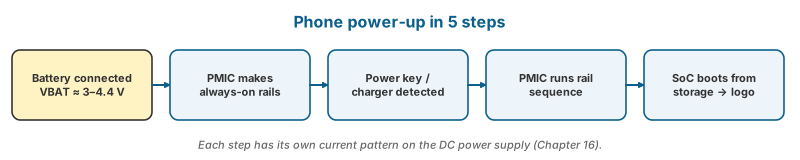
- Battery connected → VBAT (≈3.0–4.4 V depending on charge) reaches the PMIC and charging IC.
- PMIC generates always-on rails (RTC, a few low-voltage rails); waits for power-key signal.
- User presses power (or charger connected) → PMIC runs its power sequence → main rails come up.
- SoC releases from reset, reads its boot ROM, loads the bootloader from storage, verifies it, and boots the OS.
- Display initialises; logo appears.
Failure at any step gives characteristic current-draw behaviour on a DC power supply (Chapter 16).
Displays
| Type | Construction | Repair notes |
|---|---|---|
| LCD (IPS) with in-cell or on-cell touch | Backlit; touch in or on the panel | Cheaper; used in budget phones and older iPhones (up to iPhone 8/XR/11) |
| OLED / AMOLED | Self-emissive pixels; very thin | Used in most mid/high-end phones and iPhone X onward (except XR and 11). Prone to black ink-blot damage after drops; burn-in |
| Foldables | Flexible OLED with protective layer | Specialised; usually module replacement only |
Replacement screen grades (aftermarket market terms)
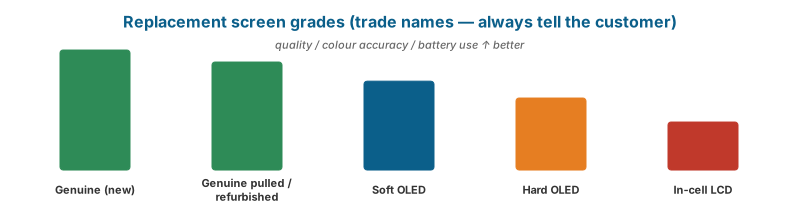
| Grade name commonly used | What it usually means |
|---|---|
| Original / genuine (new) | Manufacturer part — supplied through the manufacturer’s programmes (e.g. Apple Self Service Repair or Genuine Parts Distributors, Samsung service parts) |
| Original pulled / refurbished | Genuine panel taken from a used device, sometimes with new glass laminated on |
| Soft OLED (aftermarket) | Flexible OLED made by third parties; closer to original quality |
| Hard OLED | Rigid OLED; thicker, less colour accuracy |
| In-cell / incell LCD | An LCD substitute for an OLED phone — cheapest; noticeably worse colours, thicker, higher battery use |
These names are trade terms, not standards — quality varies between suppliers. Test samples from a supplier before buying in volume, and tell customers truthfully which grade you install (Chapter 18 covers disclosure).
Batteries
- Single cell: 3.85 V nominal on many modern phones, charged to 4.4–4.45 V; cut-off around 3.0–3.4 V depending on design.
- The battery’s small protection board contains the fuel gauge and protection MOSFETs; it reports health over a data line.
- Battery health displays: iPhone — Settings → Battery → Battery Health (or Battery Health & Charging); Samsung — Samsung Members app diagnostics / Settings → Battery and device care.
- A battery is considered “worn” at around 80% of original capacity (Apple states its batteries are designed to retain 80% at a specified number of cycles, which varies by model).
Connectors and flexes
- Board-to-board (BTB) press connectors — the main connectors for display, battery, cameras, and flexes. Very fragile; disconnect with a plastic spudger at the connector edge, straight up.
- Charge-port flex / sub-board — many Android phones have the USB-C port on a small daughterboard connected by a long flex cable (“main flex”); common, easy repair. iPhones generally have the port on a flex assembly (on some models integrated with microphones and antennas).
- Antenna coaxial cables — snap-on; disconnect by lifting straight up.
Watch and read
- Watch: Phone teardowns: see the layers for real — YouTube search: iPhone teardown iFixit
Review questions
- What does a PMIC do?
- List three differences between LCD and OLED in repair terms.
- Why should customers be told the screen grade installed?
- Describe how to disconnect a BTB press connector.
Progress is saved in this browser.