Registering a Repair Shop in the Philippines
≈ 6 min read · Print / save as PDF
Register in order: DTI business name → barangay clearance → Mayor’s Permit → BIR. Then get DTI accreditation as a service and repair shop. Renew the permit and accreditation every January.
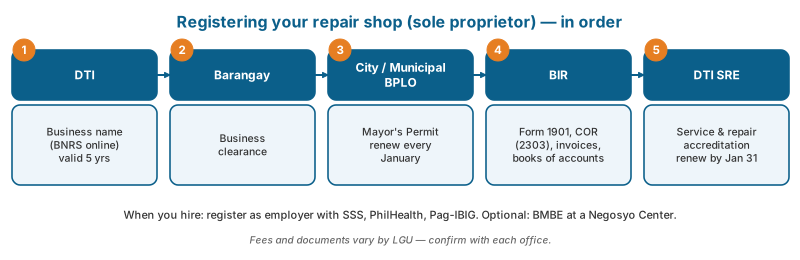
This chapter describes the registration sequence for a small repair shop as of November 2026. Requirements and fees differ between cities and municipalities and change over time — confirm each step with the agency (and consider hiring a bookkeeper or accountant for BIR compliance). This is general information, not legal or tax advice.
Step 0 — Decide the business structure
| Structure | Registers with | Notes |
|---|---|---|
| Sole proprietorship | DTI (business name) | Simplest and most common for a first shop; the owner is personally liable |
| Partnership | SEC | Two or more owners |
| Corporation / One Person Corporation (OPC) | SEC | Limited liability; more compliance work |
The rest of this chapter assumes a sole proprietorship.
Step 1 — DTI Business Name Registration
- Register online through DTI’s Business Name Registration System (BNRS). Choose a name and the territorial scope (barangay, city/municipality, regional, or national); the fee depends on the scope.
- Registering the name with DTI gives you the exclusive right to use it within the chosen coverage area.
- The certificate is valid for five years, then must be renewed.
Step 2 — Barangay Business Clearance
Apply at the barangay hall where the shop will operate. Typical requirements: DTI certificate, valid ID, lease contract or proof of address. The barangay clearance is a prerequisite for the Mayor’s Permit.
Step 3 — Mayor’s Permit / Business Permit
Apply at the city or municipal Business Permits and Licensing Office (BPLO). Typical requirements:
- Application form
- DTI certificate
- Barangay business clearance
- Community Tax Certificate (cedula)
- Lease contract or proof of address
- Sketch or photos of the location
- Zoning/locational clearance
- Fire Safety Inspection Certificate (from the Bureau of Fire Protection)
- Sanitary permit (if applicable)
Under the Ease of Doing Business Act (RA 11032), many LGUs aim to process complete small-business applications within a few working days. The permit is renewed every year in January.
Step 4 — BIR Registration
Register at the Revenue District Office (RDO) covering your business address, or online through the BIR’s ORUS system. You will need BIR Form 1901 (self-employed / sole proprietors), your DTI certificate and valid ID; LGU documents if available. Recent BIR rules (RMC 57-2020, as summarised by business-registration guides) mean you can process BIR registration and your LGU permit in parallel — but you still need the Mayor’s Permit to operate legally. Many guides advise registering with the BIR within 30 days of DTI registration to avoid penalties.
You will receive:
- Certificate of Registration (BIR Form 2303) — display it in the shop.
- Authority to print/use invoices and registration of books of accounts.
- The “Notice to Issue Invoice” sign, which must be displayed at the point of sale.
Invoices, not official receipts
Under the Ease of Paying Taxes (EOPT) Act, RA 11976 (2024) and Revenue Regulations No. 7-2024, the invoice replaced the official receipt as the primary document for sales of both goods and services. A repair shop must therefore issue an invoice (it may be titled “Service Invoice”, “Cash Invoice”, etc., as long as the word “Invoice” appears) for each job. Official receipts are now only supplementary proof of payment.
Choosing a tax option
For non-VAT individual taxpayers, the choice at registration is commonly between:
- 8% flat income tax on gross sales/receipts above ₱250,000, available if annual gross sales do not exceed ₱3 million (in lieu of graduated income tax and percentage tax); or
- Graduated income tax rates plus percentage tax.
The VAT registration threshold is ₱3 million in annual gross sales. Discuss which option fits your expected sales with an accountant, and mark your calendar for quarterly and annual filing deadlines.
Step 5 — DTI Accreditation as a Service and Repair Enterprise (SRE)
Many new shops skip this step. DTI inspects repair shops, and operating without accreditation can lead to administrative fines.
This step is often missed by new repair shops. Under Presidential Decree No. 1572 and the Consumer Act (RA 7394), enterprises engaged in the service and repair of electronics, electrical, air-conditioning and refrigeration, office equipment and other consumer products must be accredited by the DTI before operating, and their technical personnel are also subject to accreditation. Electronics repair falls under the “Electronics Service and Repair Enterprises” classification.
Key points (from DTI’s published information):
- Apply to the DTI regional/provincial office (in NCR, the Fair Trade Enforcement Bureau).
- Requirements include, among others, proof of business registration and SSS membership; DTI publishes the documentary requirements and application form on its consumer-protection pages. DTI’s accreditation rules also include lists of mandatory tools and equipment for electronics service shops — ask for the current list when you apply.
- The certificate is valid for one year and must be renewed not later than January 31 of each year.
- The certificate must be displayed conspicuously in the shop.
- DTI regularly inspects repair shops for compliance.
Factory-authorised service centres of franchised dealers are treated differently; independent shops should assume accreditation applies to them.
Step 6 — Employer registrations (when you hire)
Register as an employer with SSS, PhilHealth and Pag-IBIG (HDMF) and remit contributions. Pay at least the regional minimum wage set by your region’s wage board. Keep employment contracts and payroll records.
Optional — BMBE registration
Under the Barangay Micro Business Enterprises (BMBE) Act (RA 9178), micro-enterprises with total assets (excluding land) up to ₱3 million can register at a DTI Negosyo Center for incentives, including exemption from income tax on income from BMBE operations. Ask the Negosyo Center about current requirements, validity, and how it interacts with your BIR tax option.
Skills certification
TESDA offers national certificates relevant to this field, such as Computer Systems Servicing NC II and Electronic Products Assembly and Servicing NC II. A certificate strengthens SRE accreditation of technical personnel, builds customer trust, and is useful for students seeking employment. Check the TESDA website for current qualifications and assessment centres.
Indicative government costs
A 2026 guide published by Globe estimated total registration costs (barangay clearance, Mayor’s Permit, BIR, DTI and optional permits) of roughly ₱5,830 to ₱19,160, with the Mayor’s Permit (₱2,000–₱10,000) varying most by LGU. Add the DTI SRE accreditation fee and any notarisation, fire inspection, and signage costs. Treat these as planning estimates only.
Compliance calendar (typical)
| When | What |
|---|---|
| January (first 20 days, per LGU) | Renew Mayor’s Permit |
| By January 31 | Renew DTI SRE accreditation |
| Every 5 years | Renew DTI business name |
| Quarterly and annually | BIR returns per your tax option (ask your accountant for the exact forms and deadlines) |
| Monthly (if employer) | SSS, PhilHealth, Pag-IBIG remittances |
Watch and read
- Watch: DTI BNRS walkthrough — YouTube search: how to register business in DTI online BNRS
- Watch: BIR ORUS walkthrough — YouTube search: BIR ORUS registration tutorial
- Read/use: DTI Business Name Registration (BNRS) — Register your business name online.
- Read/use: BIR ORUS — Online BIR registration, COR, books of accounts.
- Read/use: DTI: Accreditation of Service and Repair Enterprises — SRE requirements and application form.
- Read/use: Philippine Business Hub — Government one-stop portal for business registration.
Review questions
- List the registration steps for a sole-proprietor repair shop in order.
- What is SRE accreditation, which law requires it, and when must it be renewed?
- Under the EOPT Act, what document must a repair shop issue for each service sale?
- What are the conditions for the 8% income tax option?